Why Certain Streets in Beverly Hills Command a Premium
read article
Updated June 2026
Hotel Bel-Air has outlasted almost everything around it. Studios have changed hands, neighborhoods have been rezoned, entire stretches of Los Angeles have been built, torn down, and rebuilt. The hotel at 701 Stone Canyon Road has been open since 1946, and it still operates with the same core idea it started with: a private retreat hidden in a canyon, surrounded by gardens, separated from the city by design. Jade Mills has represented properties in Bel Air for over three decades, and the hotel's story is inseparable from the neighborhood itself.
The building that became Hotel Bel-Air was never designed as a hotel. In 1922, Alphonzo Bell, an oil millionaire who had struck it rich in Santa Fe Springs, purchased over 600 acres of canyon land on the west side of Los Angeles. His wife named the property Bel-Air. Bell's plan was to develop it into a residential community for the wealthy, and he built a mission-style office on Stone Canyon Road as the sales headquarters for the project.
Next to the office, he added stables so residents could board horses and ride through the canyons. The landscape architect Mark Daniels drew up the master plan for the community. In November 1922, the first buyer paid $40,000 for a seven-acre lot. Prospective buyers had to submit letters of recommendation and pass a vetting process before they were approved to purchase. Bell was selling exclusivity as much as land, and the strategy worked.
That mission-style building, with its pink stucco walls and red tile roof, still stands at the center of the hotel. It's the same structure. The bell tower you see today was part of Bell's original construction.
In early 1946, a Texan hotel entrepreneur named Joseph Drown purchased 18 acres of the property from the Bell estate. He saw something in the canyon that others hadn't: the bones of a hotel that could feel like a private residence. Drown hired architect Burton Schutt to convert the mission-style office into a 62-room hotel, and he personally oversaw the landscaping.
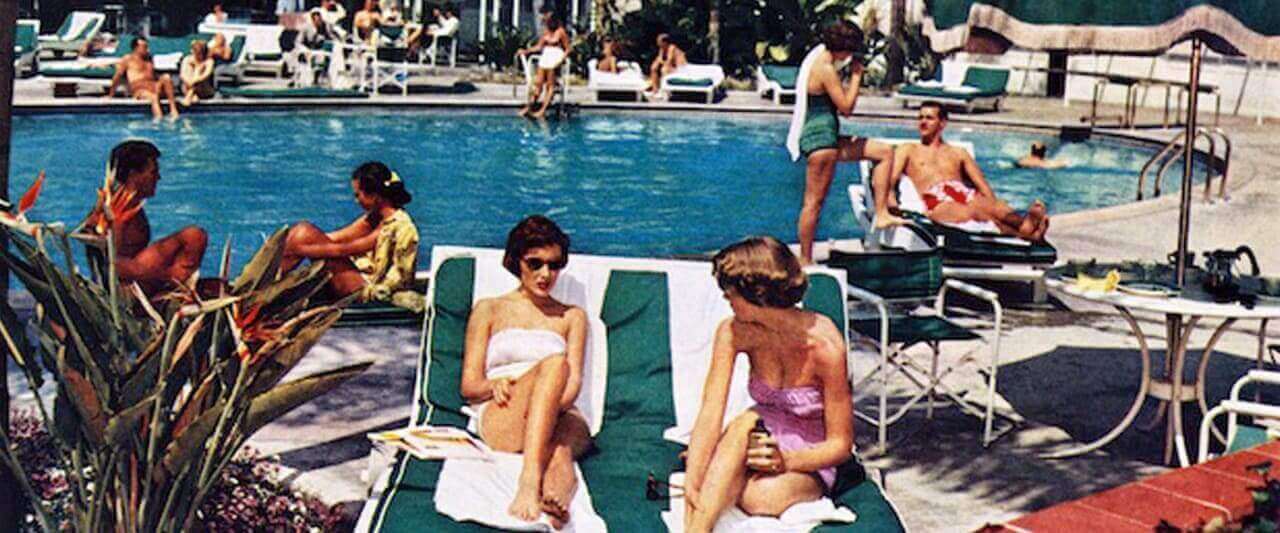
Drown added Swan Lake, which guests still cross by footbridge to reach the main building. He closed the stables and installed an oval swimming pool in the exact footprint of the original riding ring. He planted ficus, fig trees, palms, and thousands of flowering plants. The grounds eventually grew to include over 1,200 species.
The hotel opened on August 24, 1946. Drown's vision was specific: this would be a place that felt like an oasis, not an institution. No grand lobby, no convention halls, no signage visible from the road. You had to know it was there to find it. That principle still holds.
|
A detail worth noting The oval pool at Hotel Bel-Air sits on the exact spot where Alphonzo Bell's riding ring once stood. When Drown converted the stables, he kept the footprint and filled it with water instead of sand. |
From the beginning, Hotel Bel-Air attracted people who valued privacy over spectacle. Grace Kelly stayed so frequently that the hotel named a suite after her. She chose it for her post-Oscar photo shoot. Marilyn Monroe lived at the hotel on and off during her marriages to Joe DiMaggio and Arthur Miller. She knew the property well enough to treat it as a second home.
In late June 1962, six weeks before her death, Monroe sat for photographer Bert Stern in Suite 261. The session lasted twelve hours and produced 2,571 portraits. It became known as The Last Sitting. Stern chose the hotel because he knew Monroe would feel comfortable there. A second round of sessions followed over three days in Bungalow 96, with a full production team. Monroe reportedly found the larger crew less comfortable than the intimacy of the first session.
The guest list across those early decades reads like a studio contract: Elizabeth Taylor, Robert Wagner, Judy Garland, Bette Davis, Lauren Bacall, Paul Newman, Robert Redford, Jimmy Stewart, Audrey Hepburn. These weren't publicity appearances. These were people choosing a place where they could be left alone.
Joseph Drown ran the hotel until his death in the 1980s. The property then passed to the Hunt family of Texas and became part of the Rosewood Hotels & Resorts collection. The Hunts kept the hotel's character largely intact but brought in Wolfgang Puck to consult on the food program, a decision that shaped the hotel's dining identity for decades to come.
In 1995, Prince Jefri Bolkiah of the Brunei royal family purchased the property. In 2008, the hotel was folded into the Dorchester Collection, the luxury hotel group owned by the Brunei Investment Agency. The Dorchester Collection also operates The Dorchester and 45 Park Lane in London, Le Meurice and the Plaza Athénée in Paris, and several other properties worldwide.
What's notable about these transitions is how little the hotel's core identity shifted. Each owner understood that the value of Hotel Bel-Air was the thing Drown built in 1946: a sense of seclusion that no amount of renovation should compromise.
In 2009, the Dorchester Collection closed Hotel Bel-Air for a complete renovation. The project lasted two years. Christopher Cowdray, the Dorchester Collection's CEO, brought in two design firms: Alexandra Champalimaud and the Rockwell Group. Their brief was to modernize without erasing.
The hotel reopened on October 14, 2011. The familiar pink stucco and Spanish Colonial architecture remained. The bell tower remained. Swan Lake remained. But the interiors were rebuilt with design influences from the 1930s, 40s, and 50s, the decades when the hotel's personality took shape. The result was a property that felt both restored and contemporary, which is harder to pull off than it sounds.
Wolfgang Puck's restaurant group took over all food and beverage operations at the reopened hotel. The Restaurant at Hotel Bel-Air serves breakfast through dinner daily, and Puck's annual summer barbecue series, which returned recently after a three-year hiatus, brings in guest chefs like Francis Mallmann and Nancy Silverton.
Hotel Bel-Air came before the neighborhood around it. Alphonzo Bell built the original structure as the gateway to his community, and the hotel has carried that role for eighty years. Everything that defines Bel Air as a residential address, the privacy, the canyon setting, the sense of remove from the rest of Los Angeles, started with this property.
For residents of Bel Air, the hotel functions as a kind of private commons. It's where neighbors meet for dinner, where out-of-town guests stay, where celebrations happen in a setting that feels personal rather than commercial. The gardens are open for dining guests, and the property still feels more like someone's estate than a hotel, which was exactly Drown's intention.
Bel Air itself, along with Beverly Hills and Holmby Hills, forms the Platinum Triangle, the most concentrated collection of significant residential properties in Los Angeles. The hotel sits at the heart of that geography, both literally and historically.
|
Year |
Event |
|
1922 |
Alphonzo Bell builds a mission-style sales office and stables on Stone Canyon Road to market the new Bel-Air community. |
|
1946 |
Joseph Drown purchases 18 acres, hires architect Burton Schutt, adds Swan Lake, and opens Hotel Bel-Air on August 24. |
|
1950s–60s |
The hotel becomes a regular retreat for Grace Kelly, Marilyn Monroe, Elizabeth Taylor, and other Hollywood figures. |
|
1962 |
Marilyn Monroe sits for The Last Sitting with photographer Bert Stern in Suite 261, six weeks before her death. |
|
1980s |
After Drown's death, the Hunt family of Texas acquires the hotel. It joins the Rosewood Hotels collection. |
|
1995 |
Prince Jefri Bolkiah of Brunei purchases the property. |
|
2008 |
Hotel Bel-Air becomes part of the Dorchester Collection. |
|
2009 |
The hotel closes for a comprehensive two-year renovation led by Alexandra Champalimaud and Rockwell Group. |
|
2011 |
Hotel Bel-Air reopens on October 14 with Wolfgang Puck overseeing all food and beverage operations. |
|
2021 |
The hotel celebrates its 75th anniversary. |
The original mission-style building was constructed in 1922 by Alphonzo Bell as a sales office for the Bel-Air residential development. It was converted into a hotel by Joseph Drown and opened on August 24, 1946.
The hotel is part of the Dorchester Collection, a luxury hotel group owned by the Brunei Investment Agency. It has been under Dorchester Collection management since 2008.
Monroe lived at the hotel on and off during her marriages to Joe DiMaggio and Arthur Miller. In June 1962, six weeks before her death, photographer Bert Stern shot her final portrait session, known as The Last Sitting, in Suite 261 and later in Bungalow 96.
The Dorchester Collection closed the hotel in 2009 for a complete renovation led by designers Alexandra Champalimaud and Rockwell Group. The project preserved the Spanish Colonial architecture and Swan Lake while updating the interiors. The hotel reopened on October 14, 2011.
Wolfgang Puck's Fine Dining Group oversees all food and beverage operations. The Restaurant at Hotel Bel-Air is open daily for breakfast, lunch, and dinner.
Interested in living near one of the most storied properties in Los Angeles? Jade Mills has represented buyers and sellers in Bel Air for over thirty years. Reach out to start a conversation.