Wealth Migration to Beverly Hills: Who's Moving In and Why It Matters
read article
Updated May 2026
People assume Hollywood put Beverly Hills on the map. The truth is the other way around. Silent film stars came here first, built estates that rewrote the rules for what a home could be, and the cameras followed. A century later, those same streets, hotels, and mansions keep showing up on screen for the same reason buyers keep coming back to them: the architecture holds up, the light is unmatched, and the sense of place is impossible to replicate on a soundstage.
Jade Mills has sold homes within walking distance of nearly every landmark on this list. After three decades in Beverly Hills, she'll tell you the real stories behind these properties are more interesting than anything a screenwriter invented. This is a look at the places where the city's real history and its film history are the same thing.
Greystone Mansion. And it isn't close.
Oil magnate Edward Doheny Sr. built the 55-room estate in 1928 as a wedding gift for his son. Eighteen acres, formal English gardens, a Gothic revival mansion that looks like it was designed to intimidate. The City of Beverly Hills purchased it in 1965, and since then, hundreds of productions have used the property. Not dozens. Hundreds.
The reason is partly practical. Greystone is massive enough to pass for a villain's compound or a tech billionaire's retreat, and secluded enough that a film crew can work without shutting down traffic. But the real reason is harder to quantify: the place photographs like nothing else. Every angle suggests money, history, and a story you haven't been told yet. Directors know this instinctively.
The Big Lebowski used the grounds for the Lebowski mansion. There Will Be Blood shot key scenes inside. The Social Network, Spider-Man, Batman & Robin, The Bodyguard, The Witches of Eastwick, Death Becomes Her, The Prestige, X-Men, Ghostbusters. Even The Muppets filmed there. If you've seen a grand Los Angeles mansion on screen and couldn't name it, odds are you were looking at Greystone.
|
Worth knowing: Greystone's gardens are open to the public daily, free of charge. The formal terrace that doubled as the Lebowski estate is worth the visit alone. Most people who live in Beverly Hills have walked these grounds. Most people who visit never realize they can. |
This is one of the great Beverly Hills misconceptions. Everyone remembers Julia Roberts at the Beverly Wilshire. The hotel's 1928 facade and its striped awnings are so central to the film's identity that the property has built an entire guest experience around it.
But the Beverly Wilshire appears on screen for less than three minutes of the two-hour film. The exterior is real. The lobby scenes were shot at the Ambassador Hotel across town. The suite interiors were built on a soundstage in Burbank. The movie that defined Beverly Hills luxury for an entire generation was, in its most memorable scenes, a very convincing set.
The part of Pretty Woman that is real? Rodeo Drive. Roberts's shopping montage was filmed along the actual storefronts. The boutiques have changed hands since 1990. The energy hasn't. That three-block stretch between Wilshire and Santa Monica Boulevards is still the most recognized luxury shopping street in the world, and the film is a big part of why.
The Beverly Hills Hotel opened in 1912. Beverly Hills didn't incorporate as a city until 1914. The hotel was here first, which tells you something about the kind of place this has always been.
Painted its signature pink since 1948, the hotel has appeared in California Suite (1978), where Neil Simon's ensemble comedy filmed entirely on location in the bungalows. Maggie Smith won her Oscar for that performance. It showed up in Beverly Hills Cop, American Gigolo, Shampoo with Warren Beatty, and The Way We Were. For the better part of seven decades, if a director needed a visual shorthand for Los Angeles wealth, the Pink Palace was the first call.
That ended when a production crew's lighting rig set off the sprinkler system. The hotel banned filming after that. If anything, the restriction made the place more mythical. You can't film there anymore, but you can still walk into the Polo Lounge and sit in the same room where half a century of deals got done.
The hotel sits along the Sunset Strip corridor, a few minutes from Bel Air and the heart of the Platinum Triangle. The real estate surrounding it is some of the most significant on the Westside. That's not a coincidence.
Certain locations become so associated with a single film that people forget they existed before the cameras arrived. Rodeo Drive is not one of them. It has appeared in so many productions that no single movie owns it.
The most memorable entrance belongs to Eddie Murphy. In Beverly Hills Cop (1984), Axel Foley drives down Rodeo past Cartier, Louis Vuitton, and Fendi in what became one of the defining arrival sequences in American film. The storefronts have turned over since then. The three-block stretch still looks exactly the way you remember it.
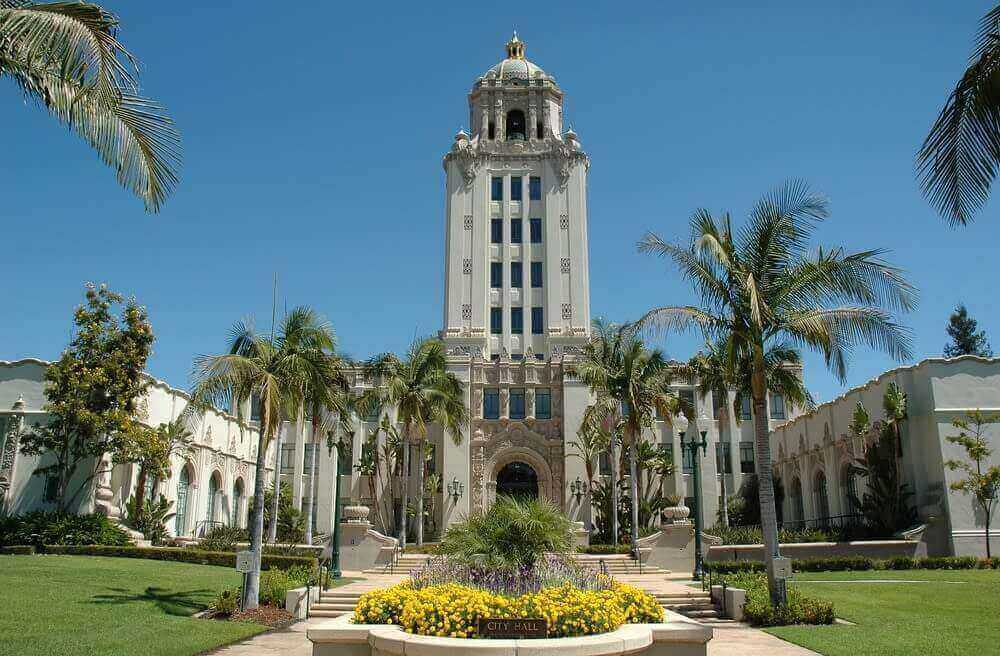
Beverly Hills City Hall played the police headquarters in the same film. It's a 1932 Spanish Colonial Revival building at 455 N. Rexford Drive, and its entrance on Crescent Drive appears every time Foley has a confrontation with Beverly Hills PD. Most cities have civic buildings that look like civic buildings. Beverly Hills has one that looks like it was designed for a movie. It wasn't. It just happens to be that well built.
A few blocks away, the fictional Whiteman house from Down and Out in Beverly Hills (1986) sits at 802 N. Bedford Drive, in the Beverly Hills Flats. Nick Nolte's character searches for his dog at the Rodeo Collection in the same film. These aren't just shooting locations. They're the actual residential streets where people live, and the fact that they double so convincingly as film sets tells you something about the caliber of what's here.
The 1995 film did more to shape a generation's idea of Beverly Hills than any property listing ever could. Two locations from the film still stop people on the street.
Beverly Hills High School played itself, which makes sense. The school has a feature so absurd that audiences assumed it was a Hollywood invention: a gymnasium with a basketball court that splits open to reveal a swimming pool underneath. It's real. It's called the Swim Gym, and it has appeared in several other films for the same reason. You can't make it up, so you don't have to.
The other location is the Spadena House at 516 Walden Drive, known as the Witch's House. Alicia Silverstone walks past it during a quiet moment in the film. The house was designed in 1921 by Oscar-nominated art director Harry Oliver, originally built as a film studio office in Culver City, then physically moved to Beverly Hills in 1926. A building that started its life on a movie set ended up becoming a movie set again, seven decades later. It's now Landmark Number 8 in the city's historic preservation registry.
|
Worth knowing: The Spadena House is a private residence, but the exterior and its overgrown storybook garden are fully visible from the sidewalk at the corner of Walden Drive and Carmelita Avenue. It's a short walk from the residential streets of the Beverly Hills Flats. |
The connection predates the talkies. In the 1920s, Mary Pickford and Douglas Fairbanks built Pickfair, their 18-acre estate in Benedict Canyon. It became the social epicenter of early Hollywood. European royalty, heads of state, and every major star of the silent era wanted an invitation to Pickfair's Sunday brunches. Getting one meant you had arrived. Not getting one meant you hadn't.
Rudolph Valentino built Falcon Lair, a Spanish Revival mansion, in 1925. He lived there for barely a year before dying at 31, but the house became a landmark that outlived his career by a century. Buster Keaton built a 10,000-square-foot Italian villa with a pool shaped like his porkpie hat. These weren't just homes. They were declarations. Beverly Hills was where you built if you'd made it, and what you built said everything about how far you'd come.
That instinct hasn't changed. The neighborhoods where Pickford and Valentino settled, from the Beverly Hills Flats to the hillside estates above Sunset, still attract buyers drawn to the same combination of privacy, prestige, and history. Streets like Roxbury Drive, where Dean Martin and Lucille Ball once lived, carry premiums rooted in that legacy. The Trousdale Estates above Beverly Hills showcase mid-century homes that appear in everything from period dramas to music videos. The architecture earns its screen time because it was built to last, not to impress a camera.
Most of them, yes. And Beverly Hills is one of the few places where they're concentrated enough to reach on foot.
Greystone Mansion: Open daily. Free. Self-guided access to the gardens and terraces.
Beverly Wilshire: The facade is visible from Wilshire Boulevard. Lobby and public areas open to visitors.
Beverly Hills Hotel: Exterior viewable along Sunset. The Polo Lounge is open for dining.
Rodeo Drive: Fully public. The same three blocks from Pretty Woman and Beverly Hills Cop.
City Hall: Exterior accessible. Best viewed from Crescent Drive.
Spadena House: Viewable from the sidewalk at 516 Walden Drive. Private residence.
The Beverly Hills Historical Society runs walking tours that connect these locations with the real stories behind them. If you're considering a move to the area and want to understand the neighborhood at a deeper level, it's time well spent.
Provenance matters in this market. It always has. A home on a street that's appeared in a dozen films carries something that doesn't show up on a spec sheet. A property with a story, a real one, not a marketing one, holds value differently than a comparable house with no history attached.
Jade Mills has represented properties throughout Beverly Hills, Bel Air, and Holmby Hills where the story of the home is inseparable from the story of the city. When you've closed sales like the Spelling Manor and the Playboy Mansion, you understand something that appraisals can't capture: at a certain level, buyers aren't choosing a floor plan. They're choosing a legacy.
The same qualities that brought directors here, the light, the architecture, the scale, the sense of arrival when you turn onto certain streets, are exactly what bring buyers here now. That hasn't changed in a hundred years. Browse current properties in Beverly Hills to see what's available.
|
Beverly Hills didn't become famous because cameras showed up. Cameras showed up because something extraordinary was already here. A century later, the same thing keeps drawing people in. The architecture. The light. The feeling that you're standing somewhere that matters. If you're considering becoming part of that story, Jade Mills has spent thirty years helping people find their place in it. |