How New Wealth Sectors (AI, Venture Capital & Crypto) Influence LA Lu...
read article
The Beverly Hills Flats is the flat, tree-lined residential core of Beverly Hills, and one of the most expensive neighborhoods in the United States. Bounded by Santa Monica Boulevard to the south, Sunset Boulevard to the north, Doheny Drive to the east, and Whittier Drive to the west, the Flats is where the majority of Beverly Hills residents actually live. Jade Mills, who has represented properties on nearly every street in the Flats, sees the same pattern with buyers year after year: they come for the address, they stay for the neighborhood.
While the hillside estates above Sunset get the cinematic attention, the Flats operates on a different frequency. This is a neighborhood built for daily life at the highest level, with wide streets, mature canopy trees, and a flat grid that puts world-class shopping and dining within close reach of your front door.
Most luxury neighborhoods in Los Angeles trade on views, elevation, or seclusion. The Flats trades on something rarer: a genuinely residential, walkable feel in the middle of one of the most recognizable cities on the planet.
Lot sizes here average between 11,000 and 15,000 square feet in the 500 blocks, and climb to 25,000 to 30,000 square feet in the 700 and 800 blocks closer to Sunset. That is significantly larger than what you will find in other parts of Beverly Hills or the surrounding Westside. The flat terrain means every square foot of a lot is usable, with no hillside grading, retaining walls, or driveway switchbacks eating into the footprint.
The result is a neighborhood of generously proportioned homes set back from the street, fronted by manicured lawns, and shaded by mature trees. Gated entries and long driveways are standard. Pools are common, and the largest properties accommodate both pools and tennis courts without feeling crowded.
|
Buyer Insight: Many buyers on the Flats renovate extensively or rebuild entirely. Even so, the architectural variety is protected by the neighborhood's character. This is not a community of identical estates. Each home has its own identity, and that is a significant part of the appeal. |
One of the first things buyers notice about the Flats is how many styles coexist on a single block. Spanish Colonial Revival estates from the 1920s, with stucco walls, red-tile roofs, and wrought-iron balconies, sit a few doors down from English Country homes with steep gabled roofs and Tudor detailing. Georgian colonials, French Provincial properties, and mid-century modern residences all share the same zip code. And increasingly, striking new construction in transitional and modern styles is filling in where older homes once stood.
That range is intentional. The Flats was developed primarily during the 1920s and 1930s, when Beverly Hills began attracting studio executives, silent film stars, and East Coast industrialists. Each brought their own architectural preferences, and the neighborhood absorbed all of them. Famous architects Harold Levitt, Rex Lotery, and Wallace Neff all built homes here. Today, firms like Ehrlich Yanai Rhee Chaney Architects continue that tradition.
What unites the homes is scale and upkeep. The City of Beverly Hills maintains its streets and public spaces to an exceptionally high standard, and there is a sense of civic pride in the Flats that keeps private property looking just as sharp. Regardless of whether a home was built in 1928 or 2025, it is maintained with the same attention to detail.
The Flats has a quiet, block-by-block character that surprises people who expect uniformity from such a prestigious address. Many streets are defined by a single species of tree, giving each one its own look and feel throughout the seasons.
Beverly Drive gets the towering palms you have seen in every film set in Los Angeles. Maple Drive is actually canopied by Liquidambar (American Sweetgum) and Camphor trees rather than true maples, though the name has stuck for a century and most passersby would never know the difference. Elm Drive is lined with Chinese Elms, which produce a dense, spreading canopy that creates deep shade in the summer months. These are small details, but they give each stretch of the neighborhood a distinct identity. Longtime residents sometimes describe their address by the trees on their street rather than the cross streets.
That level of neighborhood texture, where a two-block walk takes you through entirely different settings, is rare in any major city. It is one of the reasons the Flats has maintained its appeal across generations of buyers.
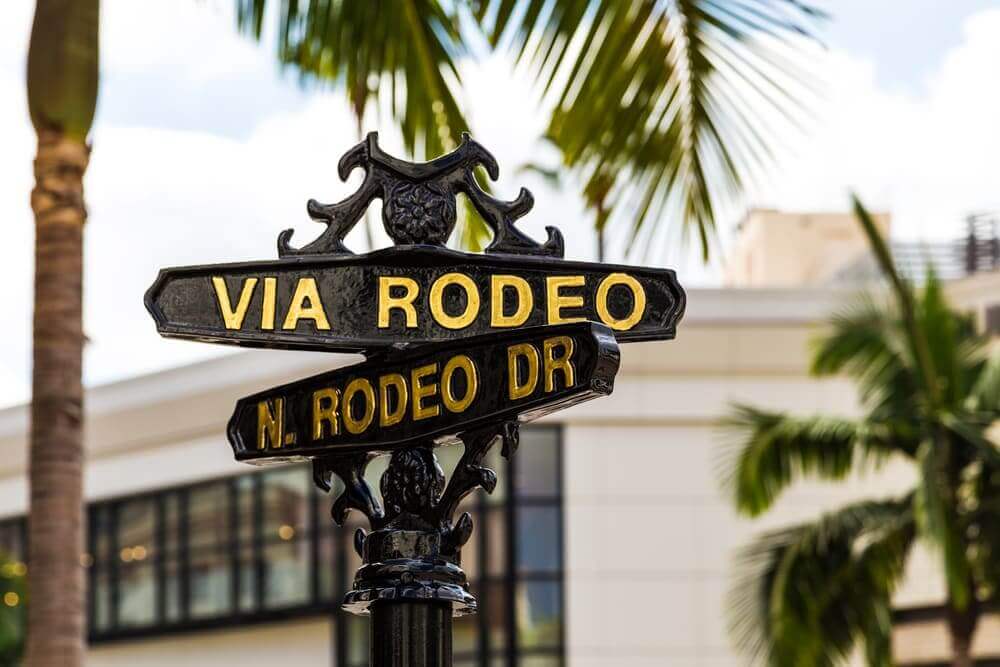
The Flats sits directly north of the Golden Triangle, the commercial heart of Beverly Hills anchored by Rodeo Drive. Saks Fifth Avenue, Louis Vuitton, and hundreds of designer boutiques are within walking distance. Dining options run from Michelin-starred restaurants like Spago and Maude to upscale casual spots scattered along Beverly, Canon, and Camden drives.
Beverly Gardens Park runs parallel to Santa Monica Boulevard and stretches two miles through the southern edge of the neighborhood. Fully renovated in 2014, the park features walking and jogging paths, public art, fountains, specialty gardens, and the famous Beverly Hills sign. Will Rogers Memorial Park sits at the northern border of the Flats, offering a quieter setting with shaded pathways and a pond.
The Beverly Hills Unified School District serves the Flats, and it is one of the highest-performing public school districts in Los Angeles County. Hawthorne Elementary and El Rodeo Elementary, both serving TK through 5th grade, fall within or adjacent to the Flats boundaries. Students in 6th through 8th grade attend Beverly Vista Middle School, located just south of the Flats, and Beverly Hills High School is a short drive beyond that. Several well-regarded private schools, including Page School and Good Shepherd Catholic School, are also in the immediate area.
|
Local Tip: The southern blocks of the Flats (the 500s and 600s) are genuinely walkable to the Golden Triangle's restaurants, shopping, and Beverly Gardens Park. The 700 and 800 blocks near Sunset are a longer walk (1.5 miles or more to a grocery store or pharmacy), so most residents there still drive for day-to-day errands. The flat terrain and grid layout still make the neighborhood far more pedestrian-friendly than any hillside community, but this is Beverly Hills, not Manhattan. A car remains part of daily life. |
The Flats has always attracted buyers who want both privacy and proximity. The residential streets feel tucked away and quiet, yet everything Beverly Hills is known for, the shopping, the dining, the cultural events, is a short walk or drive away.
Roughly 4,900 people live in the Flats. The median household income is well above $250,000, with a significant share of residents earning in the top 1% nationally ($600,000 and up). The household size averages three, which reflects a strong presence of families. But the buyer profile is wide: entertainment executives, international investors, multi-generational families who have been in the neighborhood for decades, and younger buyers drawn to new construction.
The Flats also sits within the Platinum Triangle, the three adjacent neighborhoods of Beverly Hills, Bel Air, and Holmby Hills that collectively form the most exclusive residential corridor in Los Angeles. Buyers considering the Flats are often comparing it directly with Trousdale Estates (which offers elevation and views but smaller lots) or Beverly Park (which offers gated seclusion but trades away walkability). The Flats offers something neither of those can: a flat, usable lot on a tree-lined street within walking distance of the best retail and dining in the city.
Pricing in the Beverly Hills Flats varies significantly by block and lot size. In the 2026 market, entry-level pricing for a tear-down or original-condition home in the 500 blocks starts at $7 million to $9 million, and fully renovated properties command considerably more. Move north into the 700 and 800 blocks, where lots expand and proximity to Sunset Boulevard adds cachet, and prices regularly reach $20 million to $40 million and above for the largest estates.
New construction has been a major driver of activity in recent years. Buyers are purchasing older homes on large lots, demolishing, and building from the ground up, often with full-home automation, drought-conscious landscaping, and energy-efficient systems. These new builds can command significant premiums, but they also raise the overall quality of the housing stock in the neighborhood.
Inventory on the Flats tends to be limited. Homes change hands less frequently than in many other luxury markets because owners hold on to them, sometimes for decades. When a well-positioned property does come to market, it moves quickly. Working with an agent who has deep relationships in the neighborhood, and who often knows about properties before they hit the MLS, makes a meaningful difference.
Browse current homes for sale in Beverly Hills Flats to see what is available now.
|
Neighborhood |
Terrain |
Typical Lot |
Walkability |
Best For |
|
Beverly Hills Flats |
Flat |
11K-30K sqft |
High |
Families, walkability |
|
Trousdale Estates |
Hillside terraces |
8K-15K sqft |
Low |
Views, single-story |
|
Beverly Park |
Gated hilltop |
1-3 acres |
Very low |
Privacy, acreage |
|
Holmby Hills |
Rolling |
0.5-3 acres |
Low |
Estates, legacy |
The Flats rewards buyers who have the right guide. Inventory is limited, relationships matter, and many of the best properties never reach the open market. Jade Mills has represented more transactions in the Flats than nearly any other agent in the neighborhood's history. Whether you are exploring homes for sale in Beverly Hills or considering what your current property might be worth, a conversation with Jade is the right starting point.